
CBG vs. CBD vs. CBN: What's the Difference and Which One Do You Need?
Posted by Kris Petersen on May 2nd 2026
Cannabinoid Education
CBG vs. CBD vs. CBN: What's the Difference and Which One Do You Need?
Three cannabinoids. Three distinct biological profiles. One question most people get wrong. Here's the clearest breakdown you'll find on what CBG, CBD, and CBN actually do — and how to know which one belongs in your wellness routine.
CBD. CBN. CBG. If you've spent any time in the hemp wellness space, you've seen all three — but most content treats them as interchangeable variations of the same thing. They're not. Each cannabinoid has a distinct origin, a different biological mechanism, and a meaningfully different effect profile. Understanding the difference isn't just academic — it determines which product will actually work for what you need.
This guide breaks down all three clearly and honestly — what each one is, how it works, when to use it, and how the three interact when combined. No overclaiming. No oversimplification. Just the clearest cannabinoid comparison available.
One important note before we begin: cannabinoids are not drugs and are not intended to diagnose, treat, cure, or prevent any disease or condition. What follows is an educational overview of cannabinoid science — not medical advice.
Start Here: What Are Cannabinoids?
Cannabinoids are naturally occurring compounds produced by the hemp and cannabis plant. The plant produces over 100 of them — but CBD, CBN, and CBG are three of the most studied and most commercially relevant. Each one interacts with the body's endocannabinoid system (ECS) — a vast regulatory network of receptors and signaling molecules that helps maintain balance across the nervous system, immune system, and many other physiological processes.
The ECS has two primary receptor types: CB1 receptors, found primarily in the brain and central nervous system, and CB2 receptors, found primarily in immune and peripheral tissues. Different cannabinoids interact with these receptors — and other receptor systems — in different ways. That's where the differences between CBD, CBN, and CBG become meaningful.
Why This Matters
Most people start with CBD — and for good reason. But CBD is one tool in a larger toolkit. CBN and CBG interact with the same system through different pathways, producing different outcomes. Knowing which tool to reach for — and when — is the difference between a supplement that works and one that sits in a drawer.
CBD — The Foundation Cannabinoid
CBD (cannabidiol) is the most abundant and most well-researched cannabinoid in the hemp plant. It's synthesized directly by the plant through its own biosynthetic process — unlike CBN, which forms from the degradation of THC over time. This abundance makes CBD the most accessible and most affordable cannabinoid, and its broad research base makes it the most understood.
CBD's effect profile is broad and balanced — which is both its greatest strength and the reason many people underestimate it. It doesn't produce a sharp, targeted effect the way CBN or CBG can. Instead it works as a broad regulator — supporting the body's ability to maintain balance across multiple systems simultaneously.
Mood & Stress Resilience
CBD modulates serotonin receptors and inhibits the breakdown of anandamide — your body's naturally produced "bliss molecule" — which supports emotional balance, stress resilience, and a general sense of calm without sedation.
Physical Recovery Support
CBD's interaction with CB2 receptors in peripheral tissues supports physical comfort and recovery — which is why it's become popular among athletes and active people for post-workout and general physical wellness use.
Evening Wind-Down Support
While CBD is not sedating, its stress-resilience and physical comfort effects make it a useful evening tool — easing the transition from the demands of the day into genuine rest. This is why CBD pairs so powerfully with CBN for sleep support.
CBD in a sentence
CBD is your all-day, every-day foundation cannabinoid — calm, balanced, non-sedating, and effective across a broad range of wellness goals. It's the cannabinoid that works best when used consistently, and it amplifies the effects of both CBN and CBG when combined.
Best time to take: Morning, afternoon, or evening — CBD is appropriate any time of day and does not cause drowsiness at standard doses.
Best for: Daily stress resilience, mood balance, physical recovery support, general wellness, and as a foundation for CBN or CBG combinations.
CBG — The Focus & Energy Cannabinoid
CBG (cannabigerol) is one of the most exciting cannabinoids in the hemp plant — and arguably the most underappreciated. Often called the "mother cannabinoid" by researchers, CBG is the biosynthetic precursor from which most other cannabinoids — including CBD and THC — are derived. As the plant matures, CBG is converted into other cannabinoids, which is why it's typically present in very small concentrations in mature hemp plants. Extracting meaningful amounts of CBG requires harvesting younger plants or cultivating CBG-dominant strains, making it more expensive to produce than CBD.
CBG's effect profile is distinct from both CBD and CBN — and it tends to surprise people. Where CBD is broadly balancing and CBN is sedating, CBG leans in the opposite direction: it is associated with mental clarity, focus, and what many users describe as a clean, alert energy without stimulant side effects.
Dopamine System Support
CBG inhibits the reuptake of dopamine — one of the brain's primary motivation and focus neurotransmitters. This mechanism is associated with improved drive, mental clarity, and the kind of focused energy that supports productive work and training.
Alpha-2 Adrenoceptor Interaction
CBG activates alpha-2 adrenoceptors — receptors involved in attention and cognitive function. This pathway contributes to CBG's association with mental alertness and focus, making it functionally different from CBD's more calming profile.
GABA Reuptake Inhibition
CBG also inhibits GABA reuptake — which supports a state of calm focus rather than anxious energy. This combination of dopamine support and GABA modulation is what makes CBG feel energizing but not jittery — focused rather than wired.
CBG in a sentence
CBG is the daytime, performance cannabinoid — associated with mental clarity, focus, and motivated energy without the overstimulation of caffeine. It's becoming the go-to cannabinoid for athletes, entrepreneurs, and anyone who needs to show up sharp and stay that way.
Best time to take: Morning or early afternoon — CBG's energizing profile makes it ideal for daytime use. Avoid taking it too close to bedtime.
Best for: Daytime focus, mental clarity, motivated energy, pre-workout mental preparation, and high-demand workdays.
CBN — The Sleep & Recovery Cannabinoid
CBN (cannabinol) has a unique origin story that sets it apart from every other cannabinoid. Unlike CBD and CBG, which are produced directly by the hemp plant, CBN is formed through the oxidative degradation of THC over time. As hemp ages and is exposed to oxygen and light, THC slowly converts into CBN — which is why older cannabis has historically been associated with more sedating effects.
CBN's effect profile is the most targeted of the three: it is primarily associated with deep relaxation, sedation, and restorative sleep support. It is not psychoactive at standard wellness doses despite its THC origin — its affinity for CB1 receptors is estimated at one-quarter to one-tenth that of THC, which is not sufficient to produce impairment at the concentrations used in wellness products.
Direct CB1 Receptor Engagement
CBN binds more directly to CB1 receptors in the central nervous system than CBD does — producing a more pronounced sedating effect. This direct engagement is the primary mechanism behind CBN's association with deep relaxation and sleep.
TRPV2 Receptor Activation
CBN is a potent activator of TRPV2 receptors — involved in regulating body temperature and aspects of the sleep-wake cycle. This pathway is thought to contribute to CBN's ability to support deeper, more restorative sleep cycles.
Anandamide Preservation
Like CBD, CBN inhibits FAAH — the enzyme that breaks down anandamide. By extending the presence of your body's natural bliss molecule, CBN deepens the relaxation response and supports the overnight recovery that sleep is designed to provide.
CBN in a sentence
CBN is the nighttime cannabinoid — deeply relaxing, naturally sedating, and built for restorative sleep and overnight recovery. It's not for mornings, and it's not for people who need to stay sharp. It's for people who know that sleep is where real recovery happens.
Best time to take: Evening only — 45 to 90 minutes before bed. Allow 7 to 9 hours for sleep after taking.
Best for: Sleep support, deep relaxation, evening wind-down, overnight physical recovery, and anyone who finds CBD helpful but wants deeper rest.
Side-by-Side Comparison
Here's how CBD, CBG, and CBN stack up across the dimensions that matter most for wellness decision-making:
| CBD | CBG | CBN | |
|---|---|---|---|
| Origin | Synthesized by the plant | Precursor to all cannabinoids | Degradation product of THC |
| Primary effect | Broad balance & calm | Focus & mental clarity | Deep relaxation & sleep |
| Energy direction | Neutral — calm, not sedating | Upward — alert, focused | Downward — relaxing, sedating |
| Best time of day | Any time | Morning or early afternoon | Evening only |
| Psychoactive? | No | No | Not at standard doses |
| Key mechanism | Serotonin & anandamide modulation | Dopamine & GABA support | CB1 binding & TRPV2 activation |
| Works best for | Stress, mood, recovery, daily wellness | Focus, clarity, motivated energy | Sleep, deep rest, overnight recovery |
| Abundance in hemp | Major — widely available | Minor — more expensive | Minor — most expensive |
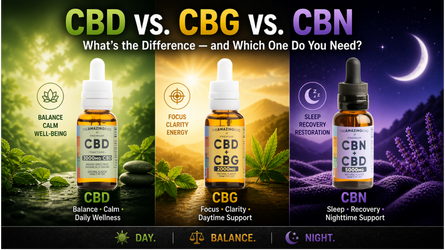
CBD is your foundation. CBG is your morning. CBN is your night. Together they cover every phase of the day — and every phase of recovery.
Which One Do You Need?
The most common mistake people make is treating cannabinoid selection like a single choice — as if you pick one and stick with it. In reality, CBD, CBG, and CBN address different needs at different times of day. The question isn't which one is best — it's which one is best for what you're trying to accomplish right now.
"I want general daily support — stress, mood, and physical recovery."
Start with CBD. A high-quality broad-spectrum CBD oil taken consistently is the foundation most people need before adding anything else. It works best when used daily, and its effects compound over time.
"I need to focus and show up mentally sharp during the day."
Add CBG. A CBD+CBG combination in the morning gives you the broad balancing effects of CBD alongside CBG's dopamine and focus support — calm, clear, and ready to work without stimulants.
"I struggle to fall asleep, stay asleep, or wake up feeling rested."
Add CBN. A CBD+CBN combination in the evening — taken 45 to 90 minutes before bed — addresses sleep from both angles: CBD easing the transition into rest, CBN deepening and extending it. This is the combination that addresses both falling asleep and staying asleep.
"I train hard and want to optimize every phase of recovery."
Use all three strategically. CBD+CBG in the morning for focus and pre-workout mental preparation. CBD on its own or paired with topicals for post-workout physical recovery. CBD+CBN in the evening for deep overnight recovery — the phase where most physical adaptation and repair actually happens.
Why Combinations Work Better Than Single Cannabinoids
One of the most consistent findings in cannabinoid research is that cannabinoids work better together than in isolation. This is known as the entourage effect — the observation that the full spectrum of hemp plant compounds produces a more complete and effective result than any single compound extracted alone.
This is why the most effective products pair cannabinoids at meaningful concentrations rather than loading up on a single one. CBD amplifies the effects of both CBG and CBN. CBG and CBN each address different systems that CBD modulates less directly. The result of combining them is genuinely greater than the sum of the parts.
CBD + CBG (Morning)
CBD provides the broad balancing foundation. CBG adds the sharp focus and motivated energy on top. Together they deliver calm clarity — the productive state where you're present, focused, and resilient under pressure.
CBD + CBN (Evening)
CBD eases the transition into rest — calming physical tension and quieting mental activity. CBN deepens and extends that rest through the night. Together they address both falling asleep and staying asleep.
Frequently Asked Questions
Can I take all three at the same time?
You can — but timing matters more than simultaneous use. CBG is best taken in the morning, CBN in the evening. CBD works any time and pairs well with both. The most effective approach is CBD+CBG in the morning and CBD+CBN in the evening — which is exactly what purpose-built combination products are designed for.
Will any of these make me feel high?
No. CBD and CBG are non-psychoactive. CBN is derived from THC but does not produce intoxication at standard wellness doses. All three are non-psychoactive when used as directed in high-quality, THC-free, broad-spectrum products.
Which one should I start with if I'm new to cannabinoids?
Start with CBD. It's the most studied, most broadly effective, and most forgiving for first-time users. Once you have a baseline sense of how CBD affects you, adding CBG in the morning or CBN in the evening gives you a much clearer read on what each cannabinoid contributes.
Why is CBG more expensive than CBD?
CBG is present in very small concentrations in mature hemp plants — most of it has already been converted into other cannabinoids by the time the plant is harvested. Producing meaningful amounts of CBG requires either harvesting younger plants or cultivating CBG-dominant strains, both of which are more resource-intensive than standard CBD production.
Do these show up on drug tests?
Standard drug tests screen for THC metabolites — not CBD or CBG. CBN, because it's derived from THC, carries a small theoretical risk at very high doses. Using broad-spectrum, THC-free products eliminates this concern at the source for all three cannabinoids.
The Bottom Line
CBD, CBG, and CBN are not competing options — they're complementary tools that address different phases of your day and different dimensions of your wellness. CBD is the foundation that makes everything else work better. CBG is the daytime performance edge. CBN is the nighttime recovery depth.
Understanding the difference isn't just useful for making a purchase decision — it changes how you think about recovery, performance, and what your body actually needs at different times of day. The people who get the most out of cannabinoids are the ones who use them intentionally, not randomly.
For people who train hard, live actively, and take their health seriously — this is the clearest framework available for building a cannabinoid routine that actually works around your life.
These statements have not been evaluated by the Food and Drug Administration. Amazing Kind products are not intended to diagnose, treat, cure, or prevent any disease or condition. This article is for educational purposes only. Consult your healthcare provider before adding any new supplement to your routine, especially if you take prescription medications.
Three Cannabinoids. Three Oils. One Routine.
The Amazing Kind makes a purpose-built oil for each phase of your day — broad-spectrum, THC-free, MCT-based, and third-party tested. Start with one or build the full routine.