
The Science of CBD: How Topical and Ingestible CBD Work in Your Body | Amazing Kind
Posted by Kris Petersen on Apr 21st 2026
CBD Science & Education
The Science of CBD: How It Works in Your Body — Inside and Out
CBD is one of the most talked-about wellness ingredients of the last decade. But most of the conversation skips the most interesting part — the actual science of how it works. Here's what's really happening when you take CBD oil under your tongue or apply a CBD topical to sore muscles.
CBD — cannabidiol — is extracted from hemp plants and has become one of the most widely used wellness supplements in the world. Millions of people use it daily in some form: oils dropped under the tongue, balms rubbed into sore joints, gels rolled onto tired muscles. But surprisingly few people understand what CBD is actually doing once it enters or contacts the body. The science is genuinely fascinating — and understanding it makes you a significantly smarter consumer.
This post covers the biology behind CBD — starting with the system in your body that it interacts with, then explaining how topical and ingestible CBD work differently, what absorption actually means, and why the method of delivery matters as much as the product itself.
One important note before we begin: CBD is not a drug and is not intended to diagnose, treat, cure, or prevent any disease. What follows is an explanation of the biological systems CBD interacts with and the mechanisms through which it is understood to work — not medical advice or therapeutic claims.
Start Here: The Endocannabinoid System
To understand CBD, you first need to understand the system it interacts with — the endocannabinoid system (ECS). This is a biological regulatory network that exists in every human being, regardless of whether they've ever used any cannabis-derived product. It was discovered in the early 1990s by researchers studying how THC affects the brain — and what they found surprised everyone: the human body already produces its own cannabis-like molecules, and has its own receptors specifically designed to interact with them.
The ECS is not a minor or peripheral system. It's one of the most widespread receptor systems in the human body — present in the brain, nervous system, immune system, skin, digestive system, muscles, and organs. Its primary function is homeostasis: helping the body maintain internal balance in the face of changing conditions.
The Science
The endocannabinoid system has three core components: endocannabinoids (molecules your body produces naturally), receptors (CB1 and CB2, found throughout the body), and enzymes that break down endocannabinoids after use. The two primary endocannabinoids your body produces are anandamide — sometimes called the "bliss molecule" — and 2-AG (2-arachidonoylglycerol). CBD interacts with this system, but not in the straightforward "lock and key" way that THC does.
The two primary receptors in the ECS are CB1 and CB2. CB1 receptors are found predominantly in the brain and central nervous system. CB2 receptors are found primarily in the immune system and peripheral tissues — including skin, muscles, and joints. This distribution is important because it explains why CBD affects different parts of the body differently, and why topical and ingestible CBD have such distinct effects.
THC — the psychoactive compound in cannabis — binds directly to CB1 receptors in the brain, which is why it produces intoxication. CBD works very differently. It doesn't bind strongly to either CB1 or CB2 receptors directly. Instead, it appears to work through multiple indirect pathways — modulating how the receptors respond, inhibiting the enzymes that break down your body's own endocannabinoids, and interacting with a range of other receptor systems including serotonin receptors, TRPV1 (the "pain receptor"), and adenosine receptors. This is part of why CBD's effects are more subtle and diffuse than THC's, and why it doesn't produce intoxication.
CBD doesn't override your body's systems. It works with them — supporting the regulatory network your body already has in place.
Full-Spectrum vs. Broad-Spectrum vs. Isolate: Why It Matters
Before getting into delivery methods, it's worth understanding the different types of CBD — because they're not all the same, and the differences have real implications for how they work.
Full-Spectrum
Contains the complete range of cannabinoids, terpenes, and plant compounds from the hemp plant — including trace amounts of THC (within the federally legal 0.3% limit). Delivers the maximum entourage effect.
Broad-Spectrum
Contains multiple cannabinoids and terpenes with all THC completely removed. Delivers the entourage effect without any THC — the best of both worlds for those who want comprehensive benefits without any THC exposure.
Isolate
Pure CBD only — all other plant compounds removed. No entourage effect. Often used in research settings where a controlled single compound is needed. Generally considered less effective for wellness applications than full or broad-spectrum.
The Entourage Effect
The entourage effect is the theory — supported by a growing body of research — that cannabinoids and terpenes work better together than in isolation. When the full spectrum of hemp plant compounds is present, they appear to interact synergistically, each modulating the effects of the others. A 2011 paper by Dr. Ethan Russo in the British Journal of Pharmacology helped establish this concept and has been widely cited in subsequent cannabinoid research. This is why full-spectrum and broad-spectrum products are generally preferred over isolate for wellness applications.
Ingestible CBD: How It Works From the Inside
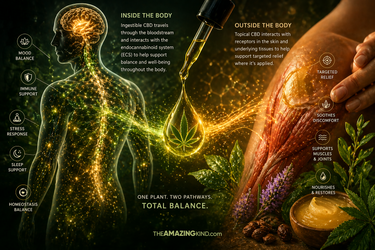
When you take CBD oil sublingually — held under your tongue — or swallow a capsule or edible, you're introducing CBD into your bloodstream, where it can interact with the ECS throughout your entire body. But the way it gets there, and how quickly, varies significantly depending on how you take it.
Sublingual Absorption — The Fastest Route
The area under your tongue is rich in blood vessels and mucous membranes that allow compounds to pass directly into the bloodstream — bypassing the digestive system entirely. This is called sublingual absorption, and it's the reason CBD oils are designed to be held under the tongue rather than swallowed immediately.
15–30 min
Initial effects felt
45–60 min
Peak effects
4–6 hours
Duration of effects
Holding CBD oil under your tongue for 30–60 seconds before swallowing is not just a ritual — it's the mechanism. The mucous membranes under the tongue absorb CBD directly into the bloodstream through a process called transmucosal absorption. Any oil that's swallowed after that point goes through the digestive system and liver (more on that below), so the sublingual hold is what gives you the faster onset.
First-Pass Metabolism — Why Bioavailability Matters
When CBD is swallowed and passes through the digestive system, it encounters what pharmacologists call "first-pass metabolism." Before reaching the bloodstream, swallowed CBD is processed by the liver, which significantly reduces the amount that actually enters systemic circulation. This is why bioavailability — the percentage of a substance that actually reaches its target — matters enormously with CBD.
Bioavailability by Delivery Method
Research suggests that oral CBD (swallowed capsules or edibles) has a bioavailability of approximately 6–19%. Sublingual CBD — absorbed under the tongue — achieves significantly higher bioavailability because it largely bypasses first-pass metabolism. This is why the same dose of CBD can feel noticeably more effective when taken sublingually than when swallowed. It's also why the carrier oil matters: fat-soluble carriers like MCT oil significantly increase bioavailability because CBD is itself fat-soluble and absorbs better in the presence of dietary fats.
Why MCT Oil Makes Such a Difference
CBD is lipophilic — it dissolves in fat, not water. This matters because the human body's absorption mechanisms for fat-soluble compounds are significantly more efficient when dietary fats are present. Medium-chain triglycerides (MCT oil), derived from coconuts, are among the most bioavailable fats available. They're absorbed directly through the intestinal wall without requiring bile acids for digestion, and they enter the bloodstream rapidly.
Using MCT oil as a carrier for CBD isn't just about taste or texture. Studies suggest that fat-soluble compounds taken with MCT oil can achieve bioavailability 3–4x higher than the same compounds taken with less bioavailable carriers like hemp seed oil or olive oil. This is why all Amazing Kind CBD oils use organic MCT oil as their base — it's the most effective vehicle for getting CBD into your system efficiently.
Taking CBD oil with a small amount of food containing healthy fats — avocado, nuts, eggs, olive oil — further enhances this effect by providing additional dietary fat in the digestive environment when any swallowed portion is processed.
What Systemic CBD Does Once It's in Your Bloodstream
Once CBD enters the bloodstream, it distributes throughout the body and begins interacting with the endocannabinoid system and other receptor systems. Because CBD is fat-soluble, it also accumulates in fatty tissues — which is why consistent daily use tends to produce more noticeable results than occasional use. Over time, as CBD builds in the system, the interaction with the ECS becomes more sustained and consistent.
The primary areas of interaction for systemic CBD include the central nervous system (via interactions with serotonin receptors, adenosine receptors, and indirect ECS modulation), the immune system (CB2 receptors are heavily concentrated in immune tissues), and the peripheral nervous system. This broad distribution is what makes ingestible CBD useful for whole-body applications — sleep support, stress resilience, mood balance, and systemic recovery — rather than the localized effects that topical CBD produces.
Topical CBD: How It Works From the Outside
Topical CBD works through an entirely different mechanism than ingestible CBD — and understanding this difference is crucial for using topical products effectively. When you apply a CBD balm, gel, or roll-on to your skin, the CBD does not enter your bloodstream in any meaningful quantity. Instead, it interacts with a localized network of cannabinoid receptors in the skin itself.
The Skin's Own Endocannabinoid System
The skin is not just a passive barrier. It contains its own local endocannabinoid system — including CB1 and CB2 receptors, the same receptors found throughout the rest of the body — along with TRPV1 receptors (which are involved in the sensation of heat and discomfort) and other receptor types that respond to cannabinoids. Research published in peer-reviewed dermatology journals has identified ECS activity in keratinocytes (skin cells), sebocytes (oil-producing cells), hair follicles, sweat glands, and sensory nerve fibers in the skin.
Research Context
A landmark 2009 review in Trends in Pharmacological Sciences established that the skin's endocannabinoid system plays a role in regulating various skin functions including cell growth, differentiation, and immune response. Since then, research into cutaneous (skin-based) cannabinoid receptors has grown significantly. This localized ECS in the skin is the primary target of topical CBD products — which is why topical CBD can produce effects at the application site without producing systemic effects throughout the body.
Skin Penetration — How Deep Does Topical CBD Go?
The skin has multiple layers, and how deeply a topical product penetrates determines what it can interact with. The outermost layer — the stratum corneum — acts as the primary barrier. Most topical ingredients, including CBD, penetrate to the dermis and interact with receptors and structures within those layers without crossing into the bloodstream.
This is good news for several reasons. First, it means topical CBD can be used without any concern about systemic effects — it's not entering the bloodstream in quantities sufficient to produce whole-body effects. Second, it means the concentration at the application site is significantly higher than it would be if the CBD were distributed systemically. A 4000mg CBD roll-on applied to a knee joint delivers a highly concentrated local dose of CBD to the receptors in that specific area — which is very different from the same amount of CBD distributed throughout your entire circulatory system.
Why the Carrier Formula Matters for Topicals
CBD is fat-soluble, which means it penetrates the skin most effectively when delivered in a lipid (fat) base. This is why professional-grade CBD topicals use carrier oils, butters, and waxes rather than water-based gels for maximum CBD delivery. The carrier also determines how long the CBD remains at the application site — a key factor in how long the effects last.
Gel / Water-Based Formula
Absorbs quickly. Cooling sensation is immediate. Effects are localized and relatively short-lived (2–3 hours). Ideal for fast, targeted relief during the day. Best for joint application and on-the-go use.
Balm / Wax-Based Formula
Beeswax creates a semi-occlusive barrier that slows CBD absorption, extending effects to 4–6+ hours. Ideal for overnight recovery and stubborn tension. More nourishing for the skin barrier. Best for nighttime and longer-duration support.
This is why Amazing Kind offers both a CBD Roll-On Gel (full-spectrum, fast-acting, targeted for joints) and a CBD Lavender Balm (broad-spectrum, extended-release, deeper penetration). They're not redundant — they use different delivery mechanisms to produce different durations of effect, and many people use both as part of a day-to-night recovery routine.
Topical vs. Ingestible CBD: Key Differences at a Glance
The two delivery methods are genuinely complementary rather than competitive. Understanding the distinction helps you use each one more effectively.
| Topical CBD | Ingestible CBD | |
|---|---|---|
| How it works | Interacts with receptors in the skin at the application site | Enters bloodstream and interacts with ECS throughout the body |
| Onset time | 1–30 minutes depending on formula | 15–45 minutes sublingual; longer if swallowed |
| Duration | 2–6 hours depending on formula | 4–8 hours depending on dose and individual |
| Effect area | Localized to application site | Systemic — whole body |
| Enters bloodstream? | No — stays at skin level | Yes — distributed throughout body |
| Best for | Targeted muscle and joint support | Sleep, stress, mood, whole-body recovery |
| Drug testing | THC-free topicals: no concern. Full-spectrum topicals: extremely low risk as CBD doesn't enter bloodstream significantly | THC-free (broad-spectrum/isolate): no concern. Full-spectrum: consult your specific situation |
Dosing: Why There's No Universal Answer
One of the most common frustrations people have with CBD is figuring out how much to take. The honest answer is that there is no universal dose — and understanding why helps set appropriate expectations.
CBD affects individuals differently based on body weight, metabolism, the specific ECS profile of the individual (which varies significantly from person to person), the concentration of the product, the delivery method, and whether it's being taken consistently or occasionally. Two people taking the same dose of the same product can have noticeably different experiences.
The "Start Low, Go Slow" Principle
The standard guidance in cannabinoid research and clinical practice is to start with the lowest effective dose and adjust gradually. For CBD oils, this typically means beginning at ½ dropper and using consistently for several days before assessing and adjusting. Because CBD builds in fatty tissues with consistent use, effects often become more noticeable after 1–2 weeks of daily use than they are in the first few days. Patience and consistency matter more than finding the "right" dose immediately.
For topicals, dosing is less of a concern — you apply to the affected area and reapply as needed. The primary consideration is the concentration of CBD in the product: higher concentrations (like the 4000mg in the Amazing Kind CBD Roll-On) deliver more CBD per application than lower-concentration products, which is meaningful for areas that need more significant support.
CBD Safety — What the Research Says
The safety profile of CBD is one of the most well-established aspects of the research. A 2018 World Health Organization (WHO) report on cannabidiol concluded that CBD is generally well-tolerated, has a good safety profile, and is not associated with abuse potential or dependence. It is non-psychoactive and does not produce the intoxication associated with THC.
That said, CBD is not entirely without considerations. It can interact with certain medications — particularly those metabolized by the cytochrome P450 enzyme system in the liver, which includes many common medications. The most frequently cited indicator is the "grapefruit warning" — if a medication warns against grapefruit consumption, it's likely metabolized by the same pathway that CBD can affect. Anyone taking prescription medications should consult a healthcare provider before adding CBD to their routine.
For topical CBD, the safety profile is even more straightforward — since it doesn't enter the bloodstream in meaningful quantities, the medication interaction concern does not apply.
Putting It Together: A Science-Based Approach to CBD
The picture that emerges from the science is one of a genuinely interesting compound that works through a genuinely interesting biological system — one that most people didn't know they had until recently. The endocannabinoid system is real, well-documented, and important. CBD's interaction with it is real and well-studied. The delivery method, the type of extract, the carrier oil, and the consistency of use all matter significantly for results.
Using CBD intelligently means understanding these distinctions: ingestible CBD for systemic, whole-body support; topical CBD for targeted, localized application at muscles and joints. Full-spectrum or broad-spectrum over isolate for the entourage effect. MCT oil as the optimal carrier. Sublingual delivery for fastest onset. Consistent daily use for best results over time.
The marketing around CBD often obscures the actual science — either by overclaiming (promises that cross into disease territory that the research doesn't support) or underclaiming (dismissing CBD entirely as unproven). The reality sits in the middle: a well-understood biological system, a compound that interacts with it in documented ways, and delivery mechanisms that are increasingly well-characterized by research. That's a solid foundation for an informed, intentional wellness practice.
These statements have not been evaluated by the Food and Drug Administration. Amazing Kind CBD products are not intended to diagnose, treat, cure, or prevent any disease. This article is for educational purposes only. Consult your healthcare provider before adding any new supplement to your routine, especially if you take prescription medications.
Explore the Amazing Kind CBD Line
Topicals for targeted muscle and joint support. Oils for whole-body recovery, sleep, and calm. All broad or full-spectrum. All third-party tested. All formulated for people who take their wellness seriously.
Shop CBD Products