
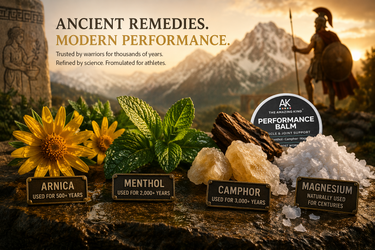
Performance Balm: Ancient Remedies. Modern Performance.
Posted by Kris Petersen on Apr 11th 2026
Recovery Science & History
Ancient Remedies, Modern Performance
Arnica, menthol, camphor, and magnesium have been used by warriors, healers, and athletes for thousands of years. Here's the remarkable history behind the ingredients in Amazing Kind Performance Balm — and why they're as relevant today as they've ever been.
Long before sports medicine clinics, foam rollers, or ice baths, human beings were figuring out how to recover from physical exertion. Roman soldiers rubbed their aching muscles with botanical oils after long marches. Alpine healers packed arnica into poultices for bruised and battered bodies. Ancient Indian physicians prescribed camphor for everything from inflammation to exhaustion. And civilizations across the world had discovered that magnesium-rich mineral baths did something remarkable for tired, tight muscles.
The ingredients in Amazing Kind Performance Balm are not trendy. They are not the result of a recent lab discovery or a wellness industry fad. They are the distilled wisdom of thousands of years of human experience with physical work, pain, and recovery — refined by modern science into a formula that works harder than anything those ancient healers could have imagined.
This is their story.
Why Ancient Remedies Still Matter
There's a tendency in the modern world to assume that newer is better — that the latest pharmaceutical innovation must outperform anything that came before it. But when it comes to topical muscle and joint support, the oldest remedies have proven extraordinarily difficult to improve upon. The reason is simple: these plants and minerals worked. Not because our ancestors didn't know any better, but because the compounds they contain interact with the human body in ways that remain deeply effective today.
When a Roman legionnaire applied a botanical compress to his legs after a thirty-mile march in full armor, he wasn't being superstitious. He was applying practical knowledge accumulated over generations — knowledge that modern pharmacology has largely confirmed. The active compounds in arnica, menthol, camphor, and magnesium don't become less effective because they're old. If anything, their track record across millennia is the most compelling proof of efficacy available.
"The history of medicine is, in many ways, the history of plants."
Let's look at each ingredient individually — where it came from, how it was used throughout history, and what it's doing in your Performance Balm today.
Arnica Montana is a bright yellow mountain flower that grows at high altitudes across Central Europe and Siberia. It looks almost cheerful — small, daisy-like, catching the thin alpine light. But for centuries, it has been one of the most trusted botanicals in traditional European medicine for one specific purpose: the physical aftermath of hard use.
The plant's use in European folk medicine dates back at least to the 16th century, when Swiss and Austrian mountain communities began applying arnica poultices to bruised limbs, strained muscles, and swollen joints after falls, heavy labor, and the grinding physical demands of alpine life. It was so consistently effective that it worked its way into formal herbal pharmacopeias across Germany, Switzerland, and Austria — and was listed in the German Pharmacopeia as early as the 1800s.
Historical Record
German poet Johann Wolfgang von Goethe — no stranger to the discomforts of age — reportedly requested arnica tea toward the end of his life to help ease his chest pains. While internal use is no longer recommended, the anecdote speaks to how deeply arnica was embedded in European healing traditions by the 18th and 19th centuries.
Mountain guides and laborers used arnica extensively throughout the Alps. After long days carrying heavy loads over difficult terrain, arnica preparations were a standard remedy. The plant became so associated with physical recovery in alpine culture that it was given the informal name Fallkraut — "fall herb" — in parts of Germany and Austria.
What makes arnica work? The plant contains helenalin, a sesquiterpene lactone, along with flavonoids and other compounds studied for their effects on soreness, swelling, and physical fatigue. Modern research supports what alpine healers discovered empirically: arnica extracts, applied topically, help ease the feeling of muscle soreness and the physical consequences of exertion — validating five centuries of traditional use.
Menthol is derived from peppermint and other mint plants, and its use in healing traditions stretches back over two thousand years across multiple continents. Ancient Chinese, Japanese, and Egyptian texts all reference mint preparations for their cooling, soothing properties. Greek and Roman physicians used mint extensively — Pliny the Elder wrote about it in his Naturalis Historia in 77 AD, describing its use for a range of physical complaints.
The Romans had a sophisticated relationship with mint and its derivatives. Mint was cultivated throughout the Roman Empire — from Britain to Egypt — and used not only in cooking and medicine but in the practical maintenance of a military force in near-constant physical use. Roman soldiers and athletes used mint-based preparations topically, recognizing what modern neuroscience would eventually explain: menthol activates the TRPM8 receptor in the skin, producing a cooling sensation without any actual change in temperature, and this sensory signal helps interrupt the perception of pain and discomfort.
Historical Record
Japanese records from as early as the 10th century document the isolation and use of menthol crystals from peppermint. Traditional Japanese medicine used menthol preparations for muscle discomfort, headaches, and physical complaints — making Japan one of the earliest cultures to isolate and use the active compound rather than the whole plant.
What menthol does in Performance Balm is deliver an immediate, sharp cooling sensation to overworked areas the moment it contacts skin. This isn't just a pleasant feeling — it's a functional signal that activates your body's natural response and helps interrupt discomfort at the sensory level. Two thousand years of empirical use, confirmed by modern receptor science.
Of all the ingredients in Performance Balm, camphor may have the most dramatic history. Derived from the camphor laurel tree, native to Taiwan, China, and Japan, camphor has been one of the most valued substances in Asian trade and medicine for three millennia. It was so prized in ancient times that it was worth its weight in gold — traded along the same routes as silk and spices, carried across the Arabian Peninsula into Europe by merchants who recognized something extraordinary in this white crystalline substance.
In ancient Chinese medicine, camphor was used to stimulate circulation, ease muscle tension, and treat a range of physical complaints. It appears in Chinese medical texts dating back to the Tang Dynasty (618–907 AD). In Ayurvedic medicine, camphor — known as karpura — was considered one of the most important medicinal substances, used in preparations for joint discomfort, muscle stiffness, and physical fatigue. Sanskrit texts from over 2,000 years ago describe its warming, stimulating properties in detail.
Historical Record
Arab physician Ibn Sina (Avicenna) — whose medical encyclopedia The Canon of Medicine influenced European medicine for 600 years — documented camphor's use for muscle complaints extensively in the 11th century. His description of camphor's warming and circulation-supporting properties aligns remarkably closely with what modern pharmacology has since confirmed.
What camphor does in Performance Balm is provide the warming counterpoint to menthol's cooling effect — creating the dual thermal sensation that activates circulation, helps ease stiffness, and signals deep recovery. Three thousand years of use across Asia, the Middle East, and Europe. The mechanism is now understood. The result remains the same.
Magnesium is one of the most abundant minerals on Earth, and human beings have been using it therapeutically for as long as recorded history. The ancient Greeks were devoted to mineral bathing — they built elaborate bath complexes around natural mineral springs, and athletes were among the most enthusiastic users. The connection between mineral-rich waters and physical recovery was so well established in Greek culture that it was woven into the rituals surrounding athletic competition at Olympia.
The Romans elevated this tradition to a cultural institution. Roman legions — expected to march up to 25 miles per day in full armor carrying equipment weighing 40–60 pounds — were stationed near mineral springs wherever possible, and bathing in mineral waters was considered essential to maintaining the physical condition of the army. Many of these springs were naturally rich in magnesium.
Historical Record
The city of Epsom, England, gave its name to Epsom salt (magnesium sulfate) in the early 17th century, when a local farmer noticed the water from a particular spring seemed to heal skin conditions and sore muscles remarkably well. Word spread rapidly, and Epsom became one of the first spa towns in England — drawing visitors specifically for the magnesium-rich waters. The tradition of "taking the waters" for muscle and joint recovery had been established across Europe for over 1,500 years by then.
Magnesium is involved in over 300 enzymatic reactions in the human body, including those that regulate muscle contraction and relaxation. When muscles are depleted of magnesium through intense exercise — and they are, since magnesium is lost through sweat — they become more prone to tightness, cramping, and the heavy, fatigued feeling that follows hard training. Topical magnesium chloride, applied directly to skin, helps replenish this mineral and supports the return of normal muscle function. The Romans didn't know about cellular biology, but they knew that soldiers who had access to mineral baths fought better and recovered faster.
When Ancient Wisdom Meets the Modern Athlete
Here's what's remarkable about these four ingredients: each of them was discovered independently, in different parts of the world, by cultures that had no contact with each other — and each arrived at the same conclusion. Physical recovery requires botanical and mineral support. The body under exertion needs help that goes beyond rest.
Roman legionnaires and Greek olympians had no way of knowing that they were onto something that would be confirmed by clinical pharmacology two thousand years later. Alpine healers packing arnica poultices hadn't studied sesquiterpene lactones. Ayurvedic physicians prescribing camphor hadn't studied TRPM8 receptors. But they all knew, through careful observation over generations, that these substances worked.
The world's best athletes have always known what science is only now confirming: recovery is where performance is made.
Performance Balm: Ancient Ingredients, Modern Formula
Amazing Kind Performance Balm was built on a simple premise: the most effective ingredients for topical muscle and joint recovery were discovered centuries ago. Modern science has confirmed why they work. Our job was to combine them in a formula that delivers their benefits as effectively and cleanly as possible — no petroleum, no parabens, no synthetic fragrances, no ingredients that don't belong.
Before Training — Prime Your Body to Move
Most people think of topical recovery products as post-workout tools — something you reach for after the damage is done. But the ancient healers who gave soldiers and athletes botanical preparations before physical exertion understood something important: priming the body before the work is just as valuable as recovery after.
Applied 10–15 minutes before training, Performance Balm uses menthol's cooling activation and camphor's warming circulation support to prepare muscles and joints for movement. Magnesium helps relax the residual tightness that builds between sessions. Arnica supports the body in managing sensations associated with pre-existing soreness — so you can move more freely from the very first rep. Less tightness at the start means better range of motion, better movement quality, and more effective training.
After Training — Support Genuine Recovery
Post-workout, Performance Balm shifts into full recovery mode. Camphor's warming effect encourages circulation to worked areas. Arnica's botanical compounds help ease the soreness and heavy feeling that follows intense training. Magnesium helps relax muscles that have been firing repeatedly under load. The lightweight grapeseed oil and mango butter base absorbs immediately without leaving a greasy residue — apply it the moment your session ends.
Daily Use — Stay Loose, Stay Moving
The Romans didn't just use their mineral baths on battle days. The Greeks didn't save arnica preparations only for the day after competition. These remedies were woven into daily life because the body accumulates tension continuously — not just from formal exercise, but from sitting, stress, repetitive movement, and the simple weight of daily activity. Performance Balm is safe for daily use on chronic tightness in the shoulders, lower back, knees, and hips.
The Bottom Line
Arnica, menthol, camphor, and magnesium have been trusted by human beings for thousands of years — through wars and Olympic games, alpine harvests and ancient trade routes, warrior cultures and healing traditions on opposite sides of the planet. They earned that trust through results.
Modern science has now explained the mechanisms. What was once empirical knowledge accumulated over generations is now understood at the molecular level. Performance Balm brings all of it together — ancient ingredients, modern formulation, zero compromise. For bodies that work hard and demand real recovery support, it's the kind of product that belongs in every training bag and every recovery routine.
Some things have been around for thousands of years because they work. This is one of them.
Ready to feel the difference?
Performance Balm is formulated with all four of these time-tested ingredients — plus eucalyptus, peppermint, and Vitamin E — in a fast-absorbing, non-greasy base built for serious training.
Shop Performance Balm